

PEI grades a glazed tile surface under ISO 10545-7. It answers for tile what the wear layer answers for vinyl.
Wear layer
The wear layer is the clear film on top of a vinyl plank. It takes every step, every grain of grit and every chair caster, and it is measured in mil, a thousandth of an inch. This guide explains the grades in common use, why a thickness and a coating are two different claims, and why vinyl is rated this way instead of by PEI.
Download as PDFWhat the wear layer is
A vinyl plank is a stack of layers pressed into one board. Near the top sits a printed film, the photograph of oak or of travertine that gives the plank its look. Over that film goes a sheet of clear vinyl with no pattern in it at all. That clear sheet is the wear layer.
It has one job. Everything that could scratch the picture has to get through it first. Grit carried in on a shoe, a dog running for the door, the caster under a desk chair: all of that works on the clear layer, not on the image. When a vinyl floor goes cloudy in a doorway or grey down a hallway, the wear layer is scratched, not the print. When it wears through, the print goes with it, and nothing puts it back.
TOP COAT
A cured finish, thinner than the wear layer and measured in microns. It handles scuffing and keeps the floor easy to clean.
WEAR LAYER
Clear vinyl over the print. The number this guide is about, stated in mil.
PRINT FILM
The image. Wood, marble, cement, whatever the plank is imitating.
CORE
The body of the plank. It decides how the floor feels underfoot and how much it moves with heat.
BACKING
A thin layer under the core, often an attached pad that quiets footsteps.
Of those five, only one is the wear layer, and only one is measured in mil.
Mil, and microns
One mil is one thousandth of an inch. It is a unit of thickness and nothing else. It is not a millimetre, and it is not a thousand of anything. Those two mix-ups are the most common ones on a sales floor. A 20 mil wear layer is 0.020 of an inch, close to half a millimetre.
European spec sheets state the same layer in microns. The conversion is fixed. One mil is 25.4 microns.
| Wear layer | The same layer, other units |
|---|---|
| 6 mil | 152 microns, 0.15 mm |
| 12 mil | 305 microns, 0.30 mm |
| 20 mil | 508 microns, 0.51 mm |
| 22 mil | 559 microns, 0.56 mm |
Read it next to the plank thickness, never in place of it. A plank of 5 mm with a 20 mil wear layer is 5 mm of floor carrying half a millimetre of clear vinyl on top. Two numbers, two different questions.
The grades and what each suits
Four thicknesses cover most of what is sold. No standards body owns these bands. They are the groupings the resilient trade has settled into, and each maker states its own use for a given product.
| Where it belongs | Wear layer |
|---|---|
| A bedroom, a closet, a spare room. Light foot traffic, no chair casters. | 6 mil |
| A family home end to end. Kids, a dog, a kitchen that gets used. | 12 mil |
| Heavy residential and light commercial. Entries, rentals, a small office, a boutique. | 20 mil |
| Commercial traffic. A shop floor, a dining room, a clinic corridor. | 22 mil and up |
In Europe the same question is answered by a use class under EN ISO 10874, where 23 is heavy residential and 33 is heavy commercial. Rigid core planks sold in the United States are commonly specified to ASTM F3261. If a maker gives you a class, read it with the mil, not instead of it.
Thickness is not hardness
Mil counts material. It does not say how hard that material is, and it says nothing about what sits above it.
Most planks carry a cured coating over the wear layer, usually a urethane hardened with UV light, sometimes loaded with fine ceramic or mineral particles. It is thin, it is measured in microns, and it is the first thing a floor gives up. It handles scuffs and keeps cleaning easy. It is not the wear layer.
So a coating and a thickness are two separate claims. A 12 mil plank with a good coating can look better after two years in a hallway than a 20 mil plank with a poor one. The 20 mil plank still has more material left to lose. Ask for both numbers. One of them predicts how the floor looks next year, the other predicts how long it lasts.
SPC, WPC and flexible vinyl
The wear layer goes on top. The core goes underneath. They are chosen separately, and the same 20 mil layer can be pressed onto any of these three.
SPC
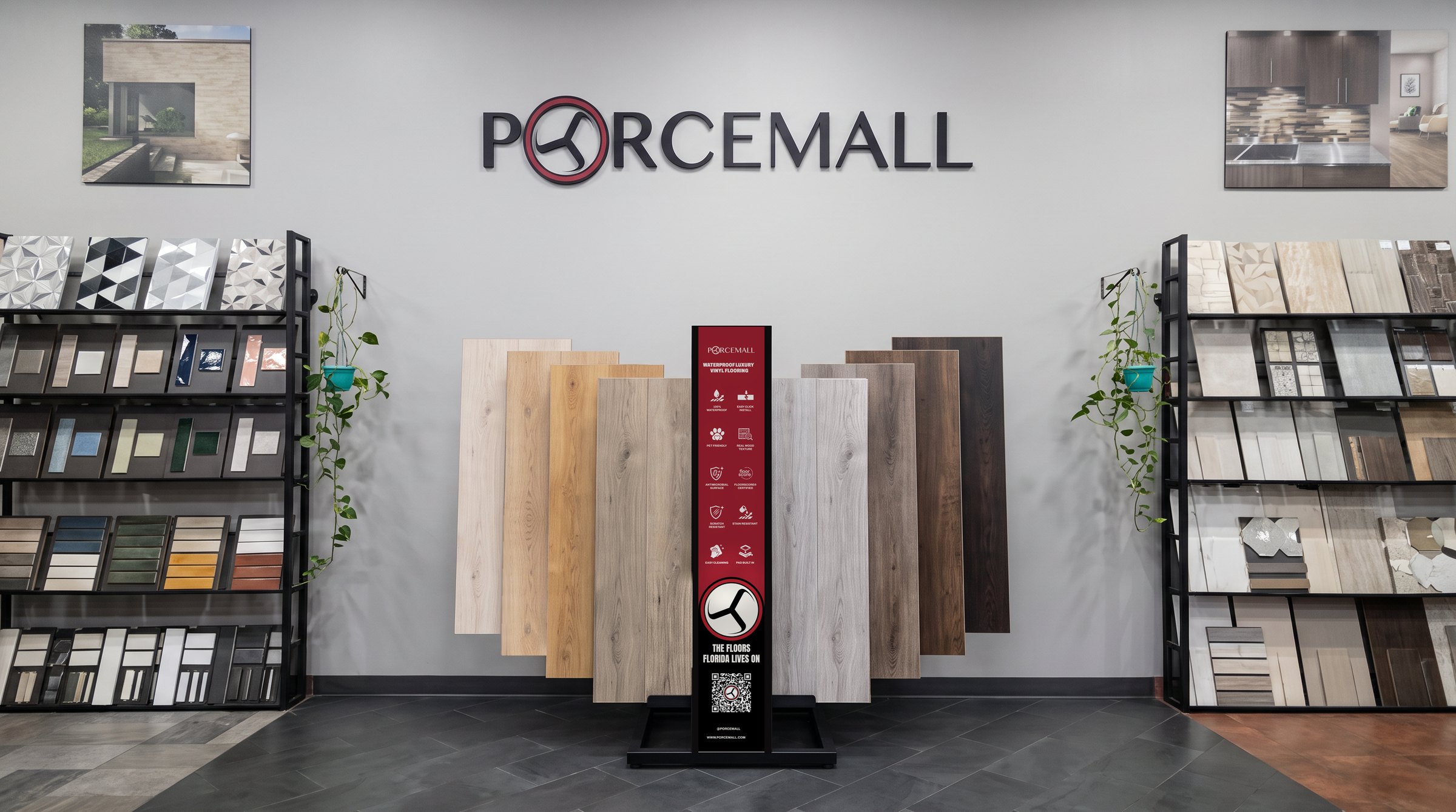
Stone plastic composite, a rigid core of limestone powder and PVC pressed dense and thin. It barely moves when a room heats up, which matters in a Florida living room with a glass slider facing west. It is hard underfoot and it will not bridge a bump, so the subfloor has to be flat. All the waterproof vinyl in the PORCEMALL catalogue is SPC.
WPC
Wood plastic composite. The core is foamed, so the plank is thicker, warmer and softer under a bare foot, and a little more forgiving over an uneven floor. Foam also moves more with temperature than stone does.
FLEXIBLE LVT
Luxury vinyl with no rigid core. Thin and bendable, glued down or laid loose. It follows the substrate exactly, so a trowel ridge or a screw head telegraphs through the surface. It asks the most of the floor prep.
SPC and WPC are both waterproof through the core, which is a different promise from water resistant. That comparison has its own guide: waterproof vs water resistant.
Why wear layer and not PEI
PEI is a tile number. Under ISO 10545-7 a lab turns an abrasive load on a glazed tile, and a panel decides at which stage the wear becomes visible. What is being graded is a fired glaze.
Vinyl has no glaze. There is no fired surface for the test to abrade, so no vinyl plank carries a PEI rating, and a spec sheet that gives one has borrowed a number from another material. The honest answer for vinyl is the material itself: how much clear vinyl stands over the print, in mil. For tile, ask for a class. For vinyl, ask for a thickness.
SPC is waterproof through the core. Laminate is water resistant. The wear layer does not change either.
The layer is clear, so what you see is the film beneath it. How many printed faces a run carries decides how often the pattern repeats.
Grit is what wears the layer down. A mat at the door and regular sweeping do more than eight extra mil.
Common questions
Is a thicker wear layer always better?
More clear vinyl is more material to lose before the print shows, so in a hallway or a shop it buys years. In a bedroom it buys very little, and you pay for material nothing will ever reach. Match the grade to the traffic, not to the biggest number on the board.
Can a worn wear layer be sanded and refinished?
No. It is not a wood finish. Sanding takes off the wear layer and the printed film under it. Once a traffic lane is worn through, those planks get replaced, which is the argument for keeping a few boxes from the same run.
Is 20 mil the same as 20 mm?
No, and the gap is enormous. 20 mil is 0.508 mm. 20 mm would be roughly forty times that, thicker than the whole plank.
Does a thicker wear layer make the floor quieter or warmer?
No. The core and the backing decide that. SPC is dense, so it reads harder and louder underfoot than a foamed WPC core, and an attached pad changes the sound far more than half a millimetre of clear vinyl ever will.
Where do I find it on a product page?
On vinyl products, alongside the plank thickness, stated in mil. Not every page carries one; ask for the tech sheet where it is missing. If a sheet gives microns instead, divide by 25.4.
Check any vinyl against this guide
PORCEMALL carries a wide range of waterproof SPC vinyl. Where a page states a wear layer it is given in mil, alongside the plank thickness and the core. Open one and read it against this guide.