

Both ramp tests, the R scale and the barefoot classes.
Pool and wet areas
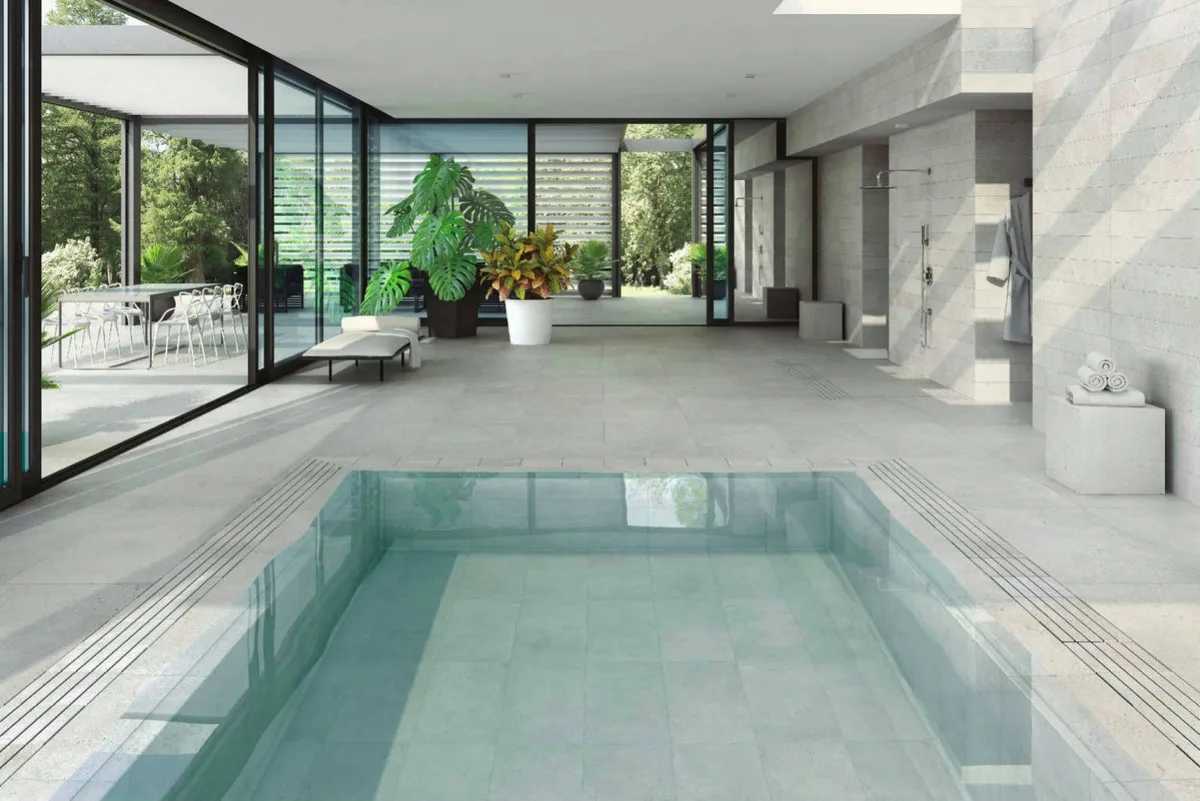
A pool is four surfaces, not one. Coping, waterline, deck and steps each get wet in a different way, and each is answered by a different line on the technical sheet. This guide covers the barefoot slip test, frost and chemical resistance, why coping is shaped instead of cut, and where the joints go.
Download as PDFThe four surfaces
Specify a pool one surface at a time. What is right for one is often wrong for the next.
COPING
The piece that caps the pool wall. People sit on it and haul themselves out of the water over it. It carries a rounded front lip and arrives shaped.
WATERLINE
The band at the surface of the water. It sits in the chemistry all day and gets scrubbed when a line builds up, so read ISO 10545-13 here.
DECK
The field around the pool. Wet feet, sun, furniture legs. The only one of the four carrying real load, so breaking strength counts as well as grip.
STEPS
Bare feet, on a slope, under water. The top barefoot class belongs here. Do not trade grip for looks.
Barefoot grip is its own test
Grip is measured on a ramp that tilts steeper until the walker slips. There are two versions. DIN 51130 uses work boots and oil, and reports R9 to R13. DIN 51097 uses bare feet and soapy water, and reports Class A, B or C, each a steeper angle than the last. Class C grips the most.
The two do not translate. A texture that holds a rubber sole is not the one that holds wet skin, so an R value says nothing about a bare foot. Slip ratings covers both scales.
| Surface | DIN 51097 class |
|---|---|
| Covered lanai, mostly dry | Class A |
| Open pool deck | Class B or C |
| Coping at the pool edge | Class C |
| Steps and ramps into the water | Class C |
Grip is not free. Class C holds dirt and sunscreen the way it holds a foot. Put it where feet meet water.
C1 grip and C3 grip
Some pool series carry surfaces the factory names C1 grip and C3 grip. They are the only surfaces named that way in the catalogue, and the first thing people misread.
They are factory names for two textures, not classes from any standard. C3 does not mean Class C. The barefoot answer sits on the DIN 51097 line and nowhere else. Each surface has its own order code, so name the surface as well as the colour when you order.
Frost and chemistry
Three ISO 10545 tests do most of the work outdoors. Where a pool page carries these results, they are printed next to their standard number.
| Standard | The test |
|---|---|
| ISO 10545-12 Frost resistance | Soaked, then frozen and thawed over and over. It passes only if nothing cracks or chips. |
| ISO 10545-13 Chemical resistance | Household chemicals and swimming pool salts, then acids and alkalis at low and high concentration. Each family gets its own letter. |
| ISO 10545-9 Thermal shock | Cycled between hot and cold. A coping baked all afternoon and then hit by a wave is this test. |
Florida still cares about the freeze test. Freezing nights reach the north of the state and the panhandle, and a deck is the wettest tile on the property when one arrives. Water inside a porous body expands as it freezes and pushes the body apart, so a pass also says how little room the tile leaves for water. The chemistry test counts whether the pool runs on tablets or on salt, because salt systems make chlorine too.
Shaped, not cut
Pool pieces are extruded. The clay is pushed through a shaped die and cut to length, so the profile leaves the machine already formed, then it is glazed and fired in the colour of the field tile. None of it can be made by cutting a flat tile, which is why a pool is ordered as a system.
COPING
Caps the pool wall. The rounded front lip is the edge you hold and step over.
COVE
Closes the corner where the pool floor meets the wall, with a small cap where two coves meet. The curve is what keeps the corner cleanable.
OVERFLOW CHANNEL
Takes the water leaving the pool. Its corner piece turns ninety degrees in one shape instead of two mitred cuts.
GRATE
The slotted lid over the channel, and its own corner. Water drops through and feet stay level with the deck.
Each piece has its own order code, and they are counted along the edge in linear feet, not by area. Count them off the plan before the order goes in.
Where the joints go
A pool deck moves. Sun heats it, water cools it, and the concrete under it keeps shrinking for months. Grout does not stretch, so the movement needs somewhere to go. That is a movement joint, filled with flexible sealant.
AT THE PERIMETER
Wherever the deck meets something that will not move with it: the coping, the house wall, a planter, a column.
ACROSS THE FIELD
At intervals across the open deck, closer outdoors than indoors because sun and water swing the temperature further. TCNA detail EJ171 sets the spacing.
OVER EVERY SLAB JOINT
A joint already in the concrete carries straight up through the tile. Tiling across one hides it for a season, then cracks the tile above it.
A grout joint is not a movement joint, however wide it is. Grout and trim covers width and grout choice.
Common questions
Is Class B enough for a pool deck?
For the open deck, yes. Class C is for surfaces walked on in water: the steps, the ramp and the coping. Where those meet the deck, running Class C throughout saves managing two surfaces.
Is C3 grip the same as Class C?
No. C1 and C3 are the factory's names for two surfaces of one colour. Class C is a result from the DIN 51097 ramp test. Read that line for slip, and treat C1 and C3 as surface choices.
Does frost resistance matter in Florida?
Occasionally, and it costs nothing to insist on. Freezing nights reach north Florida and the panhandle. The test also stands in for something useful year round, which is how little water the body takes in.
Will a salt system damage the tile?
Glaze and body are tested against swimming pool salts under ISO 10545-13, and the result is on the product page. Grout and metal fittings need attention long before the tile does.
Can I use my indoor floor tile around the pool?
Ask for its DIN 51097 barefoot class and its ISO 10545-12 frost result before you specify it. Many indoor floors report an R value and nothing else, which does not answer bare feet. The coping still has to come from a pool system.
Check any pool against this guide
PORCEMALL pool pages carry the results and the shaped pieces the factory publishes for that series, each piece with its own order code. Where a figure you need is not on the page, ask for the tech sheet. Open one and check it against this guide.